The Lesser-Known Green Spaces in London: Where to Live Nearby
The lesser-known green spaces in London are the ones residents tend to keep to themselves.
Beyond Hyde Park and Hampstead Heath, a handful of quieter parks define some of London’s most characterful and most overlooked residential pockets.
Far fewer visitors could point you to Cherry Tree Wood or Moormead, and that is precisely their appeal. These are the parks that define a neighbourhood without drawing a crowd, the ones that quietly shape where a certain kind of Londoner chooses to live.
London became the world’s first National Park City in 2019, formal acknowledgement that close to half the capital is green or blue space. Most of that greenery never reaches a listicle.
For buyers who have already researched living near a famous London park, the more useful question is where the quieter parks are, and what living beside one gives you in character and convenience. What follows is a closer look at six of the lesser-known green spaces in London, and the streets that surround each.
Cherry Tree Wood, East Finchley, N2
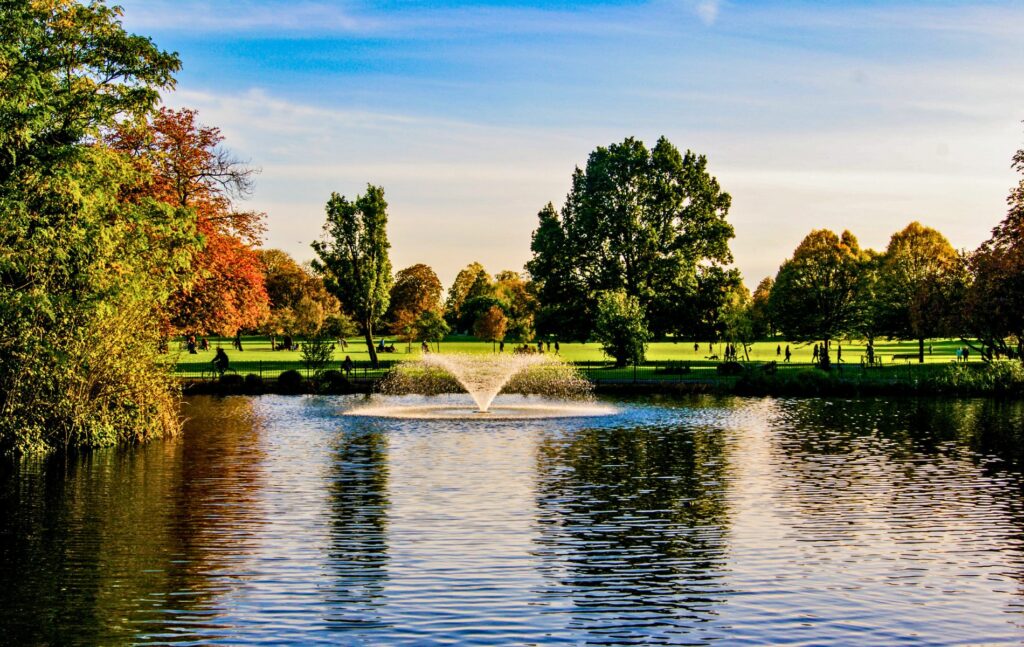
Cherry Tree Wood covers a little over five hectares of woodland and grassland opposite East Finchley Underground station on the Northern line. It has tennis courts, a playground and a café, and for the most part it stays a park used by the people who live around it rather than by anyone travelling to see it.
The surrounding streets are the real draw. Victorian and Edwardian terraces, semis and detached houses fill the roads nearest the wood, some divided into flats, others still whole family homes. Cherry Tree Hill House on the Great North Road, a gated development with underground parking, sits at the more contemporary end of the local mix.
As well as the desire to live near one of the quieter green spaces in London, families often move to the area for its schools. Martin Primary and Holy Trinity CofE Primary are both close, and Henrietta Barnett, the selective girls’ school, lies a short way off in Hampstead Garden Suburb.
The Bishops Avenue, long regarded as one of the most expensive streets in the country, begins at the northern edge of Hampstead Heath and winds down through East Finchley, ending near the station and the wood itself.
Clissold Park, Stoke Newington, N16
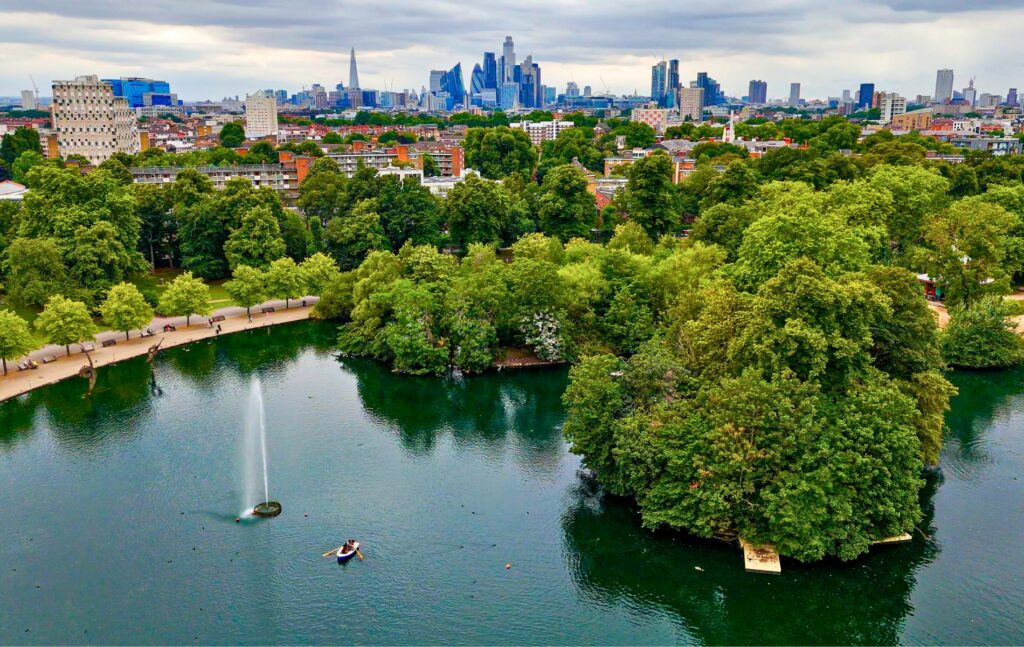
Clissold Park occupies the western side of Stoke Newington, in the London Borough of Hackney, with the Georgian Clissold House and its café at the centre. There is a paddling pool, an aviary and animal enclosures, tennis courts, a playground and an organic growing area, which suits a neighbourhood that runs the UK’s only all-organic farmers’ market.
Stoke Newington has long traded on its independence: the bookshops and delis of Church Street, the resistance to the chains that have flattened other high streets.
Property is predominantly Victorian, with a scattering of Georgian houses, and many of the period homes have been divided into flats, though whole houses of real character remain for buyers prepared to wait for one.
What gives the area a second, quieter green space is Abney Park, a former Victorian cemetery now managed as a local nature reserve, its overgrown paths and leaning headstones closer to woodland than to any manicured park. Between the two, residents seldom need to leave the postcode to find greenery.
Moormead and Bandy Recreation Ground, St Margarets, TW1
Another of the lesser-known green spaces in London is Moormead and Bandy Recreation Ground which has served as the village green of St Margarets since 1979 and forms part of the River Crane Walk. Playground, tennis courts and football pitches aside, its real function is communal. It hosts the annual St Margarets Fair, the kind of event that tells you quickly what sort of place this is.
St Margarets sits between Richmond and Twickenham, and its village core is often regarded as one of the more desirable pockets in this stretch of south-west London. Independent and boutique shops line the streets, Orleans Primary School is close, and St Margarets station runs mainline services towards Waterloo.
Housing between the station and the recreation ground is mainly Victorian and Edwardian terrace. North of The Avenue, the St Margarets Trust Grounds shift the register entirely, offering large detached houses with private gardens and access to shared communal gardens, an arrangement uncommon in London and a strong pull for families who want space without giving up the Thames.
Highbury Fields, Highbury, N5
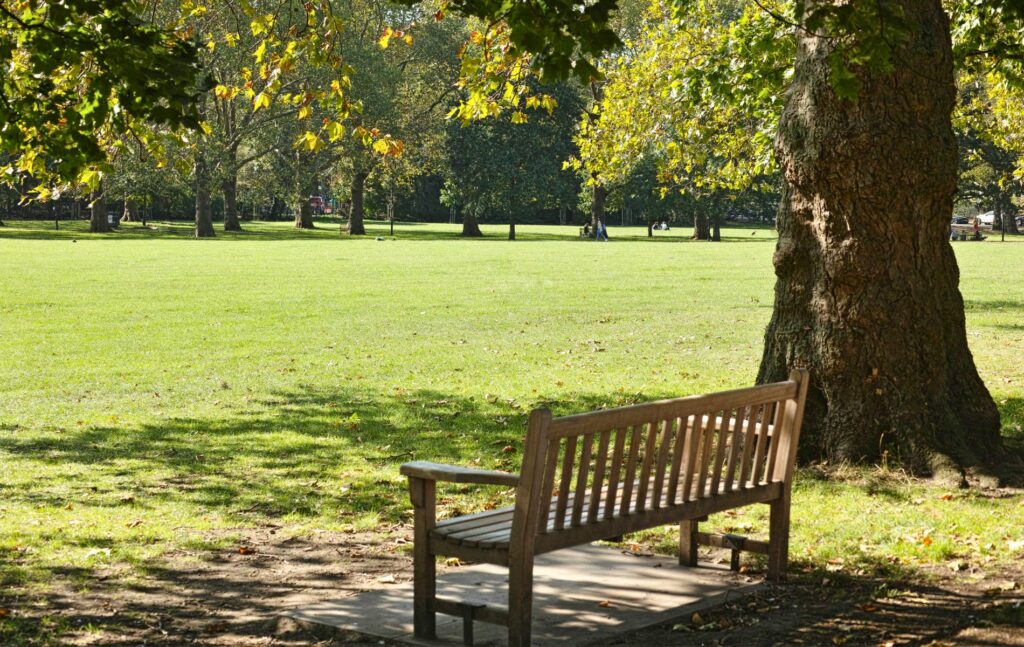
Highbury Fields is Islington’s largest open space, 11.75 hectares that opened to the public in 1885, with a Boer War memorial of 1905 standing at its southern end. Tennis courts, a leisure centre and pool, a children’s playground with water features, a football pitch and netball courts make it a working park rather than an ornamental one, and on match days it doubles as the walking route to the Emirates Stadium.
The houses around it are often considered among the most desirable in the borough. Highbury Place, where leases were first granted in 1774, Highbury Crescent, laid out from 1844, and Highbury Terrace together form a run of Georgian and Victorian townhouses facing the green.
Highbury and Islington station is close by, with the Victoria line, London Overground and national rail between them putting most of the city within easy reach. This is central Islington living at one remove: the connectivity of Zone 2, the calm of a park frontage, and a housing stock that has held its value and its appeal for two and a half centuries.
Horniman Gardens, Forest Hill, SE23
Horniman Gardens spreads across sixteen acres around the Horniman Museum in Forest Hill, given to the public in perpetuity by the tea trader Frederick John Horniman when the museum opened in 1901.
The gardens are Grade II listed on the Register of Historic Parks and Gardens, free to enter, and arranged around a bandstand and terrace with panoramic views across London, a sunken formal garden, an animal walk and a nature trail.
Forest Hill, in the London Borough of Lewisham, has quietly become, for many buyers, one of south London’s more compelling places to buy.
Property is mostly Victorian terrace and semi, with a local architectural quirk in the 1920s and 1930s houses known as “Ted Christmas” homes, after the builder who put them up. The roads closest to the gardens tend to be the most in demand.
There is more green within walking distance, too. One Tree Hill gives another viewpoint over the city, and Mayow Park adds cricket and tennis. Forest Hill station, on the London Overground, reaches Canary Wharf with a change at Canada Water and runs fast trains to London Bridge and Victoria, part of the reason the area appeals to buyers weighing up this part of south London.
Queen’s Park, NW6
Queen’s Park covers around 30 acres. Opened in 1887 to mark Queen Victoria’s Golden Jubilee, it is managed, unusually for a park this far from the Square Mile, by the City of London Corporation. It holds Green Flag status, six all-weather tennis courts, a pitch-and-putt course, a pétanque pitch and a playground with a paddling pool, and it lends its name to the neighbourhood that grew up around it.
Salusbury Road is the spine of that neighbourhood, a high street of shops, cafés and restaurants with a long-running Sunday farmers’ market. Property is predominantly Victorian terrace and mansion block, and the area is often described as one of north-west London’s more fashionable enclaves, with families drawn to it who might otherwise look towards Primrose Hill. Houses on the eastern side of the park, along the Brent and Westminster border, can command a premium over those to the west towards Kensal Rise, though much depends on the street and the property itself.
It is a distinction of only a few streets, but one that can make a real difference to price. Queen’s Park station, at the park’s edge, runs the Bakerloo line and London Overground, which keeps the area well connected while it holds on to the feel of somewhere more village than city.
Finding a home near one of the lesser-known green spaces in London
Part of the appeal of these parks is that they are not obvious. That same quality makes the housing around them harder to read from the outside, where a single street can separate an ordinary address from a coveted one, and where the right home is sometimes sold privately, before it reaches the open market. If it is the well-known parks you are after, our guide to the best places to live near a London park covers Hyde Park, Regent’s Park and Hampstead Heath among others. For the quieter corners, local knowledge counts for a great deal more.
For a discreet conversation about buying near one of the green spaces in London, or anywhere in the capital, we would welcome the chance to help. Please contact us for an initial discussion without obligation.